Hair
Clean, untreated hair clippings. For a simple starting rule, avoid hair that has been dyed, bleached, permed or chemically straightened.

Learn · From haircut to harvest
Most cut hair is swept from the salon floor and put in a bin. We rarely stop to think about what else it could be used for.
Hair is an organic material that contains nitrogen and breaks down over time. When it is added carefully to a balanced compost mix, it can become part of something genuinely useful.
In other words, the hair from your next haircut could become one ingredient in compost for a local garden.
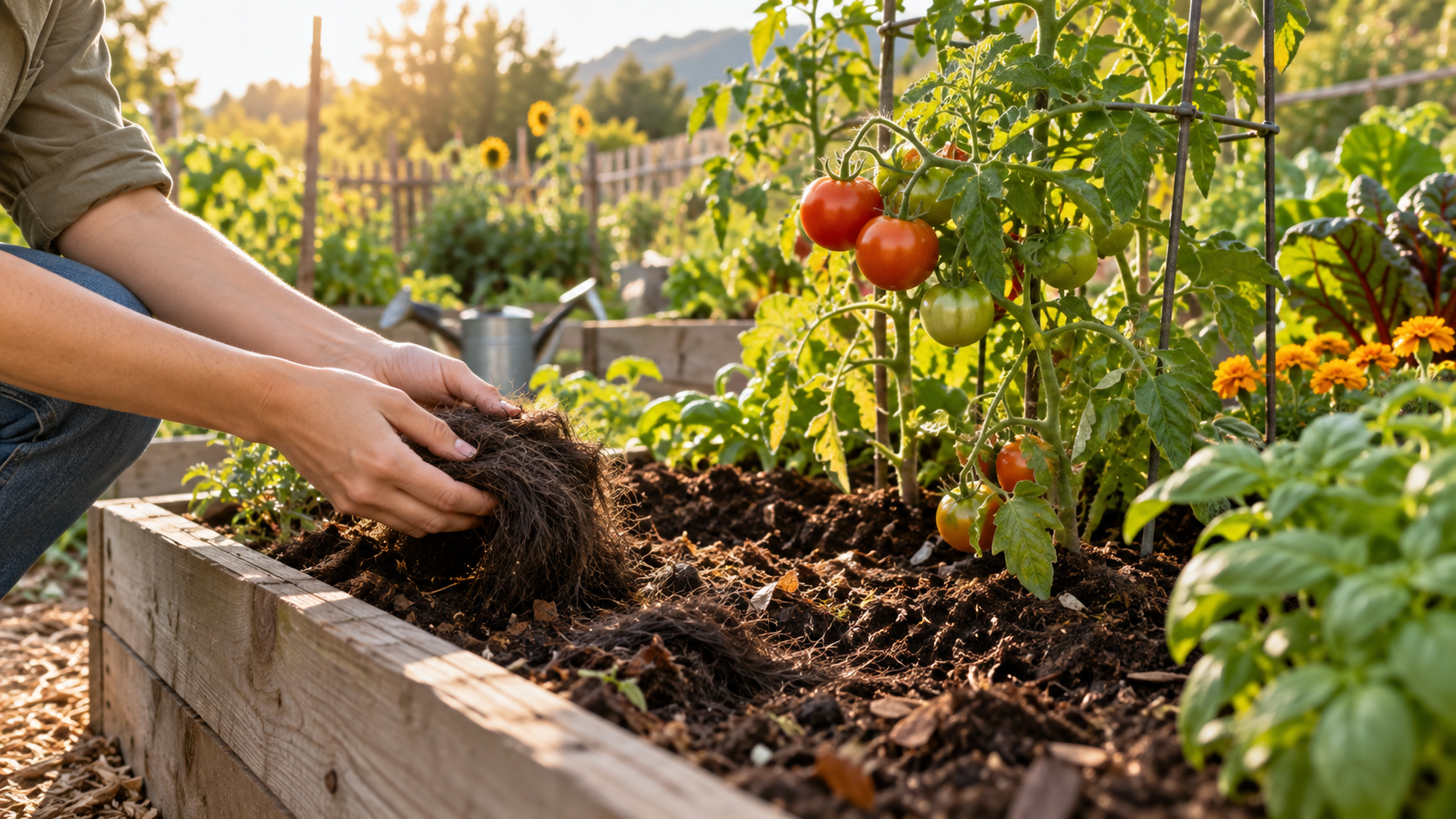
Human hair is mostly made from keratin, a tough protein. That toughness is why hair doesn't disappear quickly. Leave a banana skin in a compost heap and nature gets to work almost immediately. Hair takes its time.
But that isn't necessarily a bad thing. Hair contains nutrients, including nitrogen, and as microorganisms gradually break it down, those nutrients can become part of the compost.
Roughly how long?
In a warm, well-looked-after compost heap, hair starts to soften within a few weeks and largely breaks down in around one to two months. In a slower, cooler heap it can take several months, sometimes up to a year. Chopped or cut hair, mixed well into the pile (as in the recipe below), breaks down much faster than clumps left sitting on top.
So the trick is not to treat hair like a bottle of liquid fertiliser. You treat it like an ingredient. Think less “sprinkle hair around a tomato plant” and more “add a little hair to a big, healthy compost mix.” That's the whole idea.
You need four things:
Clean, untreated hair clippings. For a simple starting rule, avoid hair that has been dyed, bleached, permed or chemically straightened.
The fresh, damp things already going into compost: vegetable peelings, grass clippings, coffee grounds, fresh garden cuttings.
The dry stuff: cardboard, dry leaves, shredded paper, straw.
Your compost should feel damp, rather than swimming.
A simple pilot recipe
1 part hair + 4 parts greens + 5 parts browns
So if your measuring cup is a one-litre jug: 1 litre hair, 4 litres greens, 5 litres browns — roughly 10 litres of raw compost ingredients. These are ordinary materials that many composting sites already use.
Shorter pieces are easier to spread through the compost and less likely to form clumps.
Scatter the hair throughout the mixture rather than adding it in one large clump, then mix it through evenly.
Add vegetable scraps and fresh garden cuttings, along with dry materials such as cardboard and leaves. The hair should be one small part of the whole mixture.
Keep the compost damp and turn it occasionally to let in air. Hair breaks down slowly, so it is normal to see some strands for longer than the other materials.
When the compost is dark, crumbly and earthy, it can be used around flowers, vegetables, fruit, shrubs and raised beds. The hair has become one part of a useful growing material.
Not directly. It is better to think of hair as a nutrient-rich compost ingredient. Hair contains nitrogen, but much of it is locked inside keratin and needs time to break down before plants can benefit from it.
The hair has to break down first. That is why composting makes so much sense — you are letting the compost pile do the processing. Give it a month or two in a healthy heap, and the nutrients are ready for the soil.
Using the same proportions
The basic principle never changes — same recipe, bigger measuring cup.
At home
A bowl
At an allotment
A bucket
At a community garden
A wheelbarrow
At a community composting site
A bag
This means the same principle could be used at home, on an allotment or within a larger community composting system.
Imagine one busy local barber producing around 7 bags of hair every week. Using the same simple recipe, those 7 bags could become one ingredient within roughly 28 bag-equivalents of green material plus 35 of brown — around 70 bag-equivalents of raw compost ingredients.
The barber doesn't need to supply the other material. A community garden may already have leaves, cardboard, prunings, grass, old plants and food-growing waste. The hair simply joins a composting system that already exists.
They just need connecting. One person has a material they don't want. Another place has a system that could use it. The real problem may not be the hair — it may simply be that the two never meet.
That is the thinking behind hairCollective. A garden asks for hair. A barber fills a bag. A volunteer moves it a short distance. The compost pile does the rest.
Clean, dry, untreated haircut clippings. A little hair, a lot of compost.
Hair mixed with plastic, foil, tissues or other salon rubbish. For an early pilot, avoid chemically treated hair too.
The important thing is to use a small amount of hair and mix it through well.
The process at a glance
CUT → SPRINKLE → MIX → COMPOST → GROW
Cut long hair into shorter pieces. Sprinkle a small amount into the compost. Mix it with greens and browns. Compost as normal. Grow something with the finished compost. It is a familiar composting process with hair included as one ingredient.
Look at the floor. All those clippings. For most of us, the automatic thought is: waste. But maybe that is simply because we have never been given another category.
Hair is an organic material that contains nutrients and can break down over time. The opportunity may be as simple as helping it reach a nearby composting site that can use it.
Your haircut could have a useful next step in a local garden.